Categories

Johor (9) Kedah (3) Kuala Lumpur (18) Melaka (2) Negeri Sembilan (4) Pahang (13) Penang (16) Perak (4) Putrajaya (1) Sabah (11) Sarawak (2) Selangor (13) Terengganu (1)
Showing posts with label Sabah. Show all posts

Thursday, 8 May 2014

Kedai Kopi Yung Siong, Sabah

The small town of Tuaran lies 34km to the north of Sabah's state capital Kota Kinabalu. The main population consists of ethnic Dusun of the Lotud clan, with Bajau and chinese of Hakka descent making up the remainder.

Tuaran is hemmed in on three sides by a loop in the Tuaran river. On Sunday mornings, a Tamu, or open air farmers market takes place in town, with various produce on display on the streets beside the Tuaran river.

Tuaran's other item of interest is a nine-storey chinese pagoda, which is about the only prominent landmark in the town.

The name "Tuaran" itself is believed to be a corruption of the word "Tawaran", which basically means "to bargain". This alludes to the areas importance as a market place for trade and barter since before the British took control of the area in the 19th century; and still continues until today with the weekly Tamu. "Tawar" also means freshwater, which could also be a source of the name "Tuaran".

Tuaran's other claim to fame is a noodle dish called "Tuaran Mee" which is essentially handmade egg noodles which is fried and served with egg roll slices and roast meat.

However whenever I'm in Tuaran, its not the Tuaran Mee that I go looking for, but the Soto Tuaran. Soto is of course a traditional soup or broth of indonesian origin comprising of meat and vegetables. There are many variations throughout the region; while the version in Peninsular Malaysia is usually compressed rice cakes ("nasi impit") in yellow chicken broth with chicken strips, bean sprouts and fried mashed potato meat cakes ("bergedil"); the Sabah version is usually rice vermicelli with chicken, beef and other mystery cuts of meat with cucumber strips, sliced hard-boiled egg and coriander in beef broth.

The best Soto in Tuaran, and possibly the whole of Sabah is at this chinese coffee shop ("kedai kopi") called Yung Siong. Finding it is easy, just look for the old clock tower which marks the centre of the small town of Tuaran.


The Kedai Kopi is the corner lot of the row of shop houses and faces directly onto the clock tower.


In true Sabahan muhibbah (unity) style, the owner of the shop is chinese and serves the drinks, whereas the muslim lady of indonesian origin sells the food from the stall in the front of the coffee shop.


The menu consists of only three main items, Soto with various versions of mystery meats, Sup Tulang ("Bone soup") and Rujak.


Rujak is basically blanched yellow egg noodles with slices of cucumber, turnip and egg drenched in peanut sauce. It comes with a small bowl of yummy Sup Tulang. At Yung Siong you can choose to have the Rujak with beef slices ("Rujak Daging"), chicken slices ("Rujak Ayam") or both beef and chicken together ("Rujak Campur").

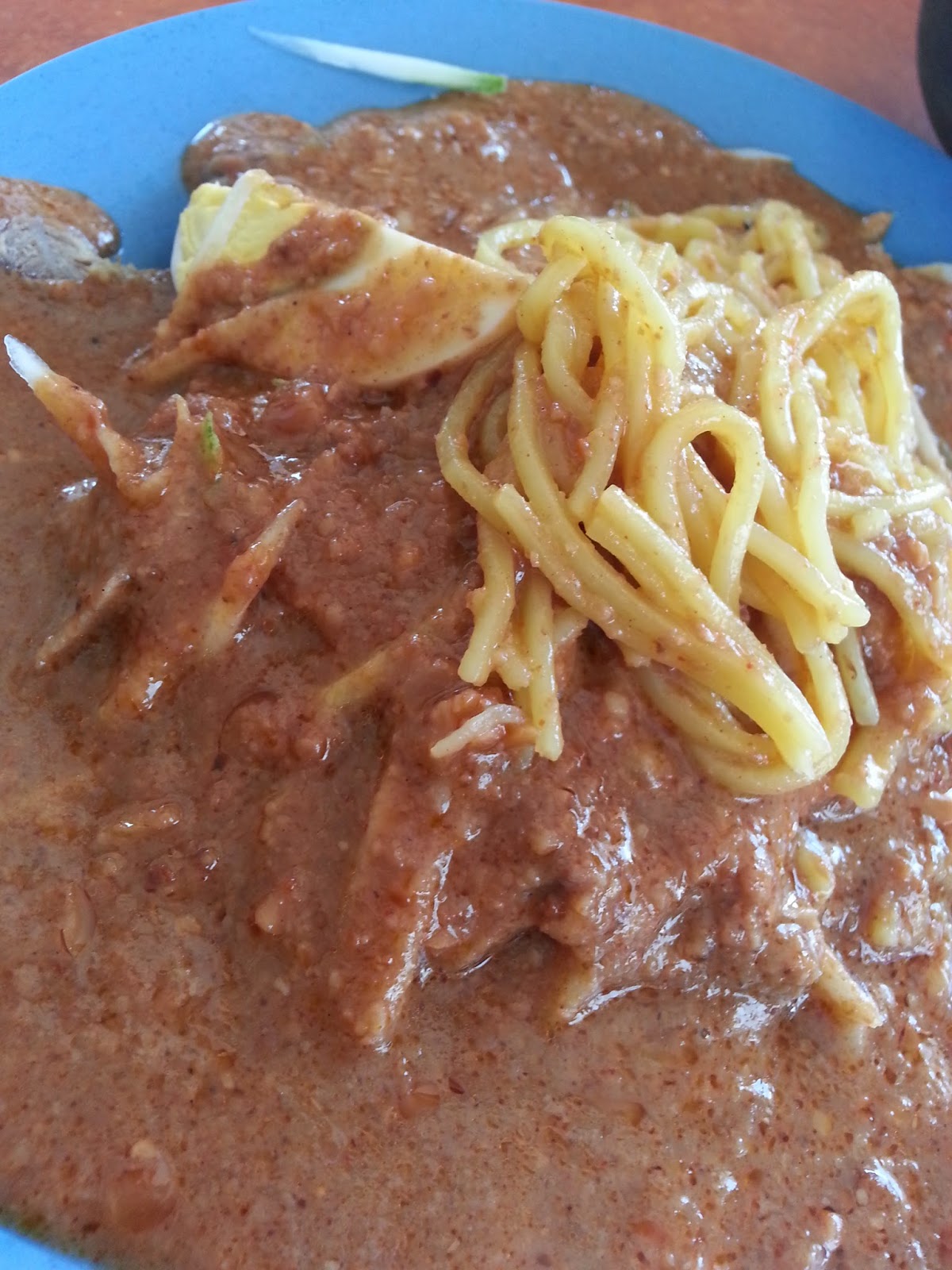

As yummy as the Rujak is, the undoubted star of the show is the Soto Tuaran. Be sure to squeeze the lime slices into the broth for the best flavour.


You can chose to have the Soto with chicken, beef or mixed; just like the Rujak. Or if you are adventurous go for the Soto Urat (tendon), Soto Perut (tripe) or Soto Usus (intestine).

If you want to try the Soto here, go early in the morning or at noon. By afternoon, it will be sold out, such is the popularity of this restaurant.


Friday, 13 September 2013

Rasa Ria Nature Reserve, Sabah


The Shangri-La Rasa Ria Resort is one of the top resorts located in the Greater Kota Kinabalu area. Its actual location is in Dalit beach, near the town of Tuaran and is about 28 km to the north of Kota Kinabalu.

Dalit Beach is perhaps one of the nicer beaches in the area, with a huge long expanse of sand and makes a nice day out to visit, although you can only gain access via through the resort. The resort also has its own golf course, for all the golfers out there.

Dalit Beach

But many hotels have beaches or golf courses; what makes the Rasa Ria different is that it has its own in-house Nature Reserve.

The Rasa Ria Nature Reserve was established by Shangri-La’s Rasa Ria Resort in collaboration with the State Wildlife Department of Sabah with the aim of protecting a 64 acre ecological space to help facilitate rehabilitation programmes for endangered species of fauna endemic to Sabah.

The Nature Reserve also provides educational programmes for local students across Sabah and actively conducts nature awareness and learning activities for visitors from all over the world. Well, basically it is for its in-house guests in particular; but outsiders are also allowed to take part in the activities with prior booking (and payment of course!).

Among the activities you can do include Bird-Watching, Jungle Walks and the Canopy Walk. And of course, the main attraction is the Orang Utan viewing sessions.

Orang Utans are only endemic to two places in the world, the islands of Borneo and Sumatra. Unfortunately, these highly intelligent primates are endangered as their natural habitats are decimated due to human population growth and deforestation. 

The Nature Reserve's role is purportedly to rehabilitate displaced orang utans before releasing them back into the wild. Visitors are allowed to view the orang utans during their feeding times, and there are normally two sessions per day, once in the morning at 10 am, and in the afternoon at 2pm.

Queuing up to pay at the entrance
Briefing before the start of the tour
Start of the trek into the reserve

Start of the hill climb

Climbing up the hill. Not too strenuous.

After 10 minutes trek, you reach the feeding platform.

Cute baby orang utan

Baby seems more interested in playing then eating.
Look at me!
Man-of-the-Forest
Advance booking is required to attend any of the activities at the Nature Resort, and needs to be confirmed 72 hours before the actual activity takes place.

Non-Malaysian non-guests are charged RM 65 per person (as of Aug'2013) and you are advised to be at the Centre 30 minutes before the stated times. You are advised to wear good walking shoes, long sleeves and pants or use mosquito repellent but we got by using none of the above without too much difficulty or inconvenience. Free bottled water is given at the end of the trip, which can last for up to 1 hour. You are allowed to leave the platform early if you had your fill of viewing the orang utans.

Update 31 Jan'16: Shangri-La has announced the successful completion of the Orang-Utan project and all remaining orang-utans at the nature reserve would be rehabilitated back to Sepilok by April 2016.

Shangri-La Rasa Ria Nature Interpretative Centre

Address : Pantai Dalit Beach, Tuaran, Sabah, 89208, Malaysia
Telephone :  +(6088) 797 888

Monday, 8 October 2012

Tip of Borneo, Sabah

The island of Borneo is the third biggest island in the world, divided between three countries; Indonesia, Brunei and Malaysia. The Malaysian part of the island is made up of two different states, Sabah and Sarawak.

Sabah is located in the northernmost part of the island of Borneo. In the northern-most part of the northern-most land of Sabah is the Kudat peninsula. These are the lands of the Rungus people; one of the many tribal groups in Sabah.

The Kudat peninsula juts out like a finger and eventually terminates at Tanjung Simpang Mengayau, the northern-most point of the island of Borneo. Tanjung Simpang Mengayau is the modern malay name for the Tip of Borneo, and is derived from the Rungus name Tanjung Sampang Mangazou.

In the Rungus language, "Tanjung" means "Tip" or "Cape"; "Sampang" means "Junction" and "Mangazou" means "Battle". This alludes to the fierce battles the Rungus fought at this Cape at the Junction of the South China Sea and the Sulu Sea, to defend their homeland against pirates and invaders.

Today, the Tip of Borneo is no longer the site of battles; but now has become the focus of tourists who come to this cape to say that they have reached the northern-most part of the island of Borneo and to come and witness the point where the waters of the South China Sea clashes with the water of the Sulu Sea.

It is here that you can also witness why Sabah is known as the Land Beneath the Wind, as the winds drive the waters of the South China Sea crashing against the rugged headland.


The nearest major town to the Tip of Borneo is Kudat. Kudat was the former first capital of British North Borneo (the predecessor of Sabah), before the capital moved to Sandakan and then to the present capital of Kota Kinabalu. Today Kudat has the feeling of being just a small frontier town, but it does have a small airport. From Kudat it is just a short drive to the Tip.

Where the roads were once just gravel, the road to the Tip has now been fully sealed, although there are still the odd bumpy sections and under repair as is usually the case in Sabah. There is also still an alternate gravel road and some of the signage can be confusing as it will direct you to the gravel road instead of the sealed one.

Eventually though you will reach the pretty Kalampunian Beach with the Tip of Borneo headland visible in the distance. As you drive along the seaside road, you will pass by Rungus stalls selling sea-shells and a couple of chalet accommodation.

The waves of the South China Sea on Kalampunian beach.
The road then climbs up the headland where you come to an open-air carpark adjacent to two chalet accommodation options, the cheaper Simpang Mengayau Chalets and the dearer TSM Merrimas Villas. Park you car here, there is no car-parking or admission fees; you can then stop for a drink at the restaurant of the Simpang Mengayau Chalets which is located overlooking the calm waters of the Sulu Sea.

The calmer waters of the Sulu Sea on the other side of the peninsula.
After your drink, you will have to walk the rest of the way to the Tip. Stop first at the viewing platform and look back at the marvelous view to Kalampunian beach.

Kalampunian beach viewed from the Tip.
Continue your walk down then up the road to where the Globe and Flag is. The Globe shows you exactly where you are on the map of the region.


Walk to the far end of the headland, and you will see steps leading down the hill to the rocks below. Walk down the steps until it ends at a barrier with a warning sign not to proceed further. Look down at the slivers of rock below which jut out into the sea, marking the end of the island of Borneo.

If you are daring, you can clamber down to the rocks below - do this at your own risk, it can be dangerous.


Admire the weird nooks and crannies that the waves have created in the rocks as the waves crash all around you.


Return back up to the top of the headland and wait for the sun to descend into the waves, painting the sky and the sea golden amidst the pounding waves and the whistling breeze. This is the Tip of Borneo!


Thursday, 27 September 2012

Bavanggazo Village, Sabah

Whereas the longhouse is a feature of the major tribal groups in neighbouring Sarawak state, it is not as commonly found in Sabah. Besides the Murut people, the only other tribe that stays in longhouses are the Rungus of the Kudat area.

However, even among the Rungus, it is becoming less and less common to be able to find the longhouse, especially the traditional form of the design.

In Kampung Bavanggazo or Bavanggazo village, you will find the traditional longhouses still in existence. As one of the four villages in the Kudat peninsula which specialises in one type of craft or skill, in this case, the Rungus Longhouse; Bavanggazo is a must visit if you have an interest in seeing how the old longhouses used to look like.


To get there is pretty simple. From the main road between Kota Marudu and Kudat, you will see the above signboard, about 40km before reaching the town of Kudat. Take the turning and follow the road for about 2.5 km to get to the Bavanggazo longhouse.


Buy your entrance tickets from the two chickens manning the ticket counter. RM5 for an adult, RM3 if you are a MYKAD holder. RM3 / RM2 for children under 12.


There are two longhouses here, both done in the traditional style. The longhouses do not house any families but are more tourist attractions than actual houses.


After visiting the Bavanggazo longhouse, you can also visit the Maranjak longhouse down the hill. The Maranjak longhouse is longer and better maintained.


The Maranjak Longhouse Lodge is also a homestay lodge. You can actually chose to stay here and if you book in advance you can actually partake in cultural performances and other activities.


Wednesday, 26 September 2012

Gombizau Village, Sabah

Traditionally honey has always been prized by the Rungus people of Kudat for its high nutritional value and other health benefits.

Kampung Gombizau or Gombizau village is the third of four villages in the Kudat peninsula where the entire village specialises in just one skill or craft. In Gombizau, the specialty of the village is the rearing of bees to produce honey.


As you approach the honey bee farm, you will see the sign as above. Park your car and approach the stall selling rows and rows of honey in bottles.


You will see the signboard displaying the price for entry into the bee farm, basically RM5 per adult or RM3 for children between 6 to 12 years. Pay the fees and sign the guestbook.

Most of the villagers manning the cooperative seem to be either women or children. One of the women will act as your guide and walk you down the road towards the forested area of rubber trees.


On the left and right of the road, you will see many 12" x 12" wooden boxes called Golodok. These are where the honey bees make their honey.


Using a strange contraption, your guide will begin to smoke the golodok to send the honey bees into a smoke induced stupor.


After the bees have been stupefied, you are given a chance by the guide to hold the honeycomb frame. The guide will also cut a bit of the raw honey from the honeycomb to give you a taste.

Soon after you return back to the stall and you may chose to purchase bottles of honey which are displayed for your selection.


While we were there, we were lucky enough to see a baby tarsier, which was kept as a pet by one of the children of the village.