Categories

Johor (9) Kedah (3) Kuala Lumpur (18) Melaka (2) Negeri Sembilan (4) Pahang (13) Penang (16) Perak (4) Putrajaya (1) Sabah (11) Sarawak (2) Selangor (13) Terengganu (1)
Showing posts with label Negeri Sembilan. Show all posts

Thursday, 11 October 2012

Istana Lama Seri Menanti, Negeri Sembilan

The Federation of Malaysia today is made up of 13 States and the Federal Territories of Kuala Lumpur, Putrajaya and Labuan.

Of the 13 states, one of the more unique ones is the state of Negeri Sembilan, to the south of Kuala Lumpur. Negeri Sembilan is Malay for "Nine States" and alludes to its past when it was an independent kingdom made up of nine districts.


The original nine districts were Klang, Naning, Rembau, Sungai Ujong, Jelai, Johol, Segamat, Ulu Pahang and Jelebu. Today, Klang is now under the jurisdiction of the neighbouring state of Selangor; Naning under the state of Melaka, Segamat under the state of Johor and much of Ulu Pahang is now in the adjacent state of Pahang.

The history of Negeri Sembilan is inextricably tied to the Minangkabau people of Sumatera and the Pagar Ruyung dynasty. Legend has it that there was once a dispute between a tribe of the Melayu kingdom in South Sumatera and a neighbouring tribe. In order to avoid outright war, a contest between buffaloes was proposed. The enemies of the Melayu brought forth a huge and aggressive buffalo, while the Melayu brought forth a baby buffalo with its horns sharpened.

The Istana in Pagar Ruyung, Sumatera, taken by me in 2013.
The baby buffalo ran forward to the adult buffalo, thinking it was its mother; which the aggressive buffalo did not see as a threat. The sharp horns of the baby buffalo punctured the belly of the aggressive buffalo, killing it on the spot, and giving the Melayu victory. Henceforth from that day, the Melayu tribe was renamed as the "Menang Kerbau" which literally means "Winning Buffalo". Over time, this became contracted to "Minangkabau".

It is believed that the Kingdom of Pagar Ruyung in Western Sumatera in what is now Indonesia, was founded by a Melayu prince called Adityawarman in 1347, possibly as a result of his victory in the "Menang Kerbau" contest. His descendants eventually consolidated power in the form of division of power to three Rulers; the King of the World ("Raja Alam") who was the paramount ruler, the King of Customs ("Raja Adat") and the King of Religion ("Raja Ibadat"). Collectively they were known as the King of the Three Seats ("Rajo Tigo Selo"). The Rajo Tigo Selo were in turn assisted by 4 ministers in charge of different areas of government. The Kingdom was organised into districts called Nagari, each with its own clans and courts, under a Federal system.

While it is not known why so many Minangkabau eventually left Pagar Ruyung to settle on the west coast of the Malay peninsula, it may be related to the tradition of "merantau" or roaming in search of new opportunities amongst Minangkabau males. Whatever the case may be, this constant settlement eventually resulted in a collection of 9 districts organised into Nagari, following the structure in Pagar Ruyung, each with its own clans and courts.

These "Negeri Sembilan" initially looked to the neighbouring Sultanate of Melaka for protection; but after that powerful sultanate fell to the Portuguese and the Dutch, their allegiance shifted to the Sultanate of Johor. When that Sultanate became embroiled in its own problems, the nine districts decided to look to their ancestral homeland of Pagar Ruyung for a new leader, thus paving the way for an independent Negeri Sembilan. The Ruler of Pagar Ruyung sent his relative Raja Melewar, to Negeri Sembilan to become their new ruler. With the consent of the Sultan of Johor, Raja Melewar became He Who is The Highest Lord of the Nine States ("Yang Dipertuan Besar" or "Yamtuan Besar").

Raja Melewar eventually made his palace in Seri Menanti, which remains the royal town to this day. Seri Menanti was a verdant valley surrounded by encircling hills. Legend has it that three stalks of rice were found waiting to grow in the valley, hence the name of Seri Menanti, "Seri" being the javanese term for rice paddy, and "Menanti" meaning waiting. At this site, Raja Melewar built his palace or "Istana".

The present "Istana Lama" or old palace in Seri Menanti is a newer structure which was erected in 1902 and completed in 1908 to replace the older palace which was razed to the ground by British soldiers in the Bukit Putus war.


The four storey timber palace was built by two carpenters in the Minangkabau style at the express wishes of the Yamtuan Besar who wanted to retain the spiritual and cultural connection to the ancestral homeland in Pagar Ruyung. Famously, the Istana Lama's timber structure was built entirely without the use of a single nail.


The four central pillars are made of Penak wood from Jelebu, and are 170 feet long without joints. In total, the whole palace has a total of 99 pillars supporting the four storey structure. The first storey has four rooms and a 160 feet long verandah. The second storey has three rooms for the use of royalty. The third storey was for the Yamtuan's private use, whilst the fourth storey was used to house the royal treasures.

Today the Istana Lama is no longer in use as a Palace, but instead houses a museum. The museum recreates the rooms of the Palace with the use of period furniture, as well as housing some of the royals memorophilia and boards telling the story of the Minangkabau and the Pagar Ruyung dynasty.

Dining Hall on the 1st Storey
Passageway to the back of Palace.
Front of the Palace
Verandah on the 2nd Storey
Steep staircase up to the 3rd Storey.
The 3rd Storey with stairs leading up and down.
The 4th Storey with 360 degree views.
View from the Top.

The Istana Lama Seri Menanti is open to visitors 7 days a week from 10 am to 6 pm, except for Fridays when it is closed from 12:15pm to 2:45pm for Friday prayers. Admission is free.


There is a small resort next to the Istana Lama that you can stay in. Seri Menanti itself is a small tranquil town where nothing seems to happen and time stands still. Along the way to the town, you will pass by pretty kampung houses and experience a slower pace of life.


Wednesday, 10 October 2012

Army Museum, Negeri Sembilan

Port Dickson has been home to an Army Camp from way back in 1933 when the Kem Si Rusa was set up. Since then, there has always been a sizeable military presence in Port Dickson, so much so that in 2009, Port Dickson was declared as an Army Town ("Bandar Tentera Darat") by the Prime Minister of Malaysia.


You could then say it would be appropriate for a museum dedicated to the Army be located in an Army Town. Located off an intersection from the 4th mile Port Dickson coastal road, the Army Museum is located right next to the army camp.


The museum has both indoor galleries and outdoor displays of army hardware. The indoor galleries are spread out over 8 galleries located in 2 blocks of double-storey buildings. Each gallery is dedicated to a particular era or theme.

One of the galleries is dedicated to the era of the Melaka Sultanate, with dioramas painting a picture of how life must have been in the ancient empire which was the pre-cursor to British Malaya.

Another gallery tells the tale of British Malaya, and the various local heroes and freedom fighters that put up resistance to the colonial rulers throughout their time in the power.


Other galleries are dedicated to the time of the formation of the Malay army, the time of the Japanese conquerors, and the communist insurgency.

As you wander around the various galleries, you will also come across some curious artifacts like this actual elephant skull.

While all the galleries are interesting enough especially if you can read Malay and have an interest in history, the real attraction for boys and grown-up boys are outside the galleries where all the military hardware and ordnance are displayed in all their glory.


Another interesting feature is a re-created mock-up of a communist underground tunnel. You walk down into the ground and into a darkened tunnel which has a communist sentry, mock surgery room, mock operations room and ammo store.


The Army Museum is open 5 days a week from Wednesday to Sunday at 10 am to 5 pm. It is closed on Monday and Tuesday.


Tuesday, 9 October 2012

Restoran Pantai Ria, Negeri Sembilan

One of the few towns in Malaysia that survived the wave of nationalism that swept through the country in the 70's which resulted in British colonial names being dropped in favour of local names, Port Dickson today is now known more for its beaches rather than the town itself. 

The beaches may not be spectacular, but they are the closest in proximity to the capital city of Malaysia, Kuala Lumpur; making it a popular weekend jaunt for the jaded city-dweller.

Like any other seaside town, sea-food is also a popular reason to head to P.D. as it is fondly known as. Numerous seafood restaurants dot the entire coastal road stretching from Port Dickson town to Cape Rachado.

Teluk Kemang, located about 7 1/2 miles from P.D. town, has the Restoran Pantai Ria which is located on the ground floor of a budget hotel of the same name.

The restaurant is on the ground floor of the hotel of the same name.
You can't miss the restaurant from the main road; just look out for this signboard on the left hand side of the road.

Look for this sign in Teluk Kemang.

The restaurant looks like a typical chinese seafood restaurant, with an open air section with round tables up front and an air-conditioned section at the back. They have obviously chosen to differentiate themselves from the loads of other chinese seafood restaurants by packaging themselves towards a muslim clientele.


The Menu

Order from the menu, plenty of choices are available. For drinks, go for the typical Lime & Plum juice, which is basically lime juice with a preserved plum or "asam boi" tossed in.

Plum and Lime Juice

Previously we had the Butter Prawns, which were good, but this time we went for the Marmite Prawns which were okay but not spectacular.

Marmite Prawns

The Kailan (chinese broccoli) with Garlic was nice, crunchy and not overly salty. A good complement to the other seafood dishes.

Kailan with Garlic

The Salted Egg Crabs are the main reason why we come to this restaurant. Every time we have been here we order this. Recommended.

Salted Egg Crab

The Mantis Prawns cooked with Dried Chillies was also spectacular. Something we would definitely try again.

Mantis Prawns with Dried Chillies

The damage for all of the above came to slightly above RM100, for 2 people. Pretty reasonable for good simple food done well.

Update 11/5/14

Seaweed Soup

Nestum Prawns


Restoran Pantai Ria

Address: Lot 3/233, Jalan Pantai, Batu 7 1/2, Teluk Kemang, 71750 Port Dickson, Negeri Sembilan.
Tel: +606-662 5122 

Sunday, 7 October 2012

Haji Shariff's Cendol, Negeri Sembilan

Cendol is one of Malaysia's favourite desserts. The dessert's basic ingredients are coconut milk (santan), a worm-like jelly made from rice flour with green food colouring (usually derived from the pandan leaf), shaved ice and palm sugar (gula melaka).

If you ever find yourself in Seremban, 68km south of Kuala Lumpur, well there is only one place to go to for cendol.

Haji Shariff Cendol once operated from a push-cart; but now it operates from its own premises in Seremban under the 3rd Generation descendants of the original owner. 


You can't miss the building, its probably the only green building in a corner shop-lot on one of Seremban's main streets Jalan Yam Tuan.

The popularity of the place is evident with all the tables full with customers and people queuing for their cendol at the counter. Yes, you read that right, its self-service here, no waiter will come to your table to take your order.
The cendol is indeed yummy, a smooth blend of the coconut milk, palm sugar, shaved ice and the green jelly. Apparently the ingredients are all natural, without the use of any artificial colouring. Perfect for a hot day!

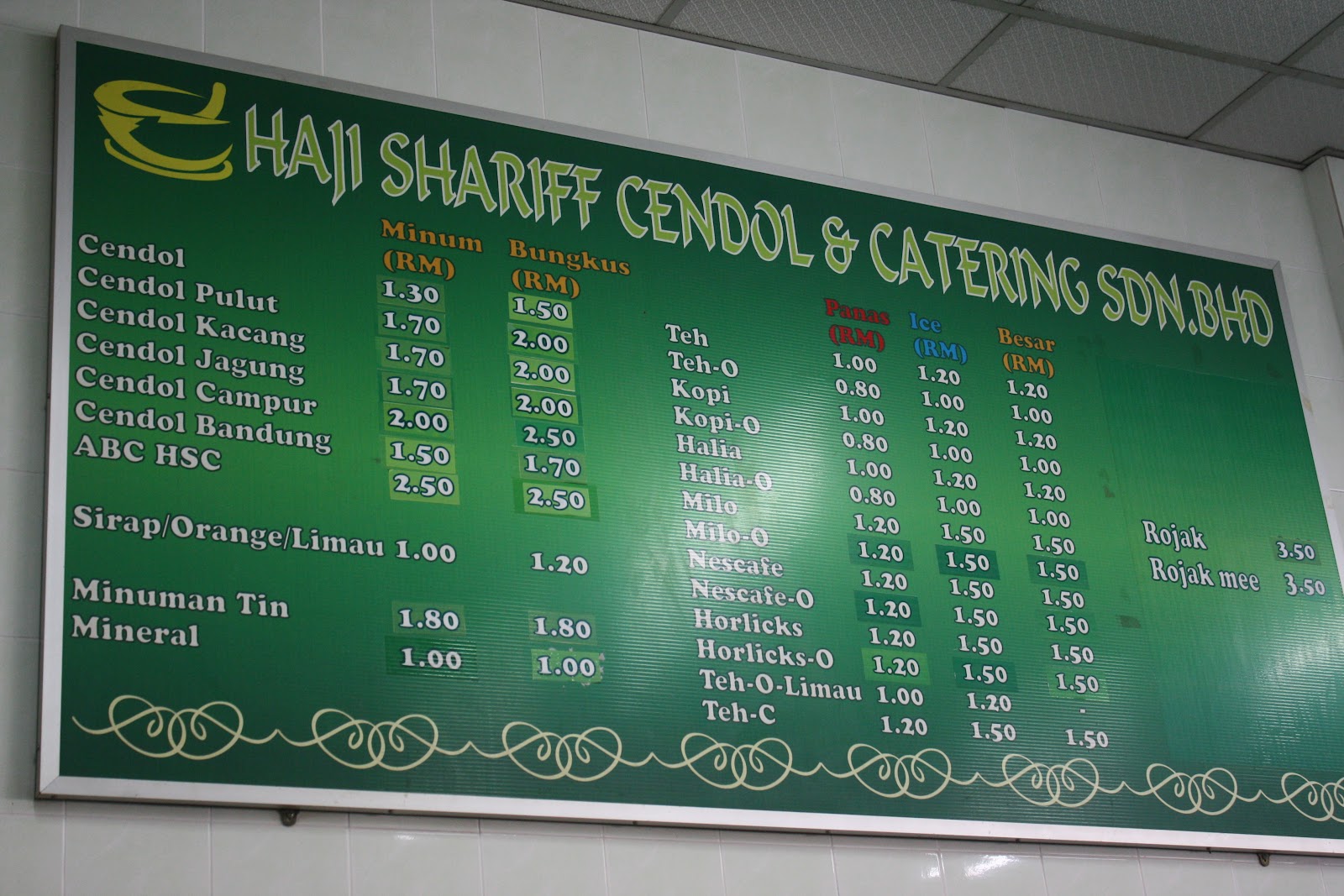
If you are looking for something more, you can add in other ingredients to your basic Cendol. You can add in glutinous rice (Cendol Pulut), red beans (Cendol Kacang), corn (Cendol Jagung) or a mixture of it all (Cendol Campur). Unfortunately no Cendol Durian!

Besides the Cendol, Haji Shariff's also serves Rojak and Rojak Mee. Rojak is of course a mixture of cucumber, bean sprouts, turnip, deep-fried bean-curd (tofu), fried dough fritters (kuih) and hard-boiled egg drenched in a sweet spicy sauce. Rojak Mee is essentially the same, with the addition of yellow egg noodles (mee).
Rojak
The popularity of the Rojak can be seen from the queue at the stall!


Haji Shariff's Cendol

Address: No 44, Jalan Yam Tuan, 70000 Seremban, Negeri Sembilan
Tel : +606-763 2741
 

Opening Hours: 10.30 am - 6.00 pm