Categories

Johor (9) Kedah (3) Kuala Lumpur (18) Melaka (2) Negeri Sembilan (4) Pahang (13) Penang (16) Perak (4) Putrajaya (1) Sabah (11) Sarawak (2) Selangor (13) Terengganu (1)
Showing posts with label Kuala Lumpur. Show all posts

Saturday, 11 November 2017

KL Forest Eco-Park, Kuala Lumpur

Bukit Nanas, which means "Pineapple Hill", is the last remaining virgin tropical jungle located in the centre of Kuala Lumpur city. Located on a small hill, it is now surrounded on all sides by major roads and high-rise buildings.

Originally known as Bukit Gombak, its story its very much tied to the history of Kuala Lumpur itself. Kuala Lumpur began when Raja Abdullah, a member of the Selangor Royal Family and Chieftain of Klang, hired chinese prospectors to venture upstream from Klang to open new tin mines in the Ampang area. Eventually mines were successfully set up in Ampang; however the tin ore had to transported downstream and supplies and provisions brought upstream by boat.

So, in 1857, a settlement was founded at the confluence where the Gombak and Klang rivers met, the nearest convenient point where boats could disembark to service the upstream tin mines of Ampang. This muddy confluence of course became the settlement of Kuala Lumpur, which is now the capital city of Malaysia.

To strengthen his control over Kuala Lumpur, Raja Abdullah sent his lieutenant Syahbandar Yaseh to establish a garrison in the area. Syahbandar Yaseh selected Bukit Gombak as a base to build his stockade.

Some time later, an incident occured whereby a villager of the Sumatran Batu Bara ethnic community was killed by someone in Yaseh's Bukit Gombak's garrison. Raja Abdullah refused to punish his ethnic Bugis men of the garrison for the crime, which angered the Batu Bara community.

Incensed, the Batu Bara headman Mohamad Akib gave his backing to Raja Mahadi, a rival of Raja Abdullah, to support Raja Mahadi should he attack Raja Abdullah. And so, the seeds of the Selangor Civil War, were sowed at Bukit Gombak.

Raja Mahadi attacked Raja Abdullah in his stronghold in Klang. Mohamad Akib was killed in the battle, and Raja Abdullah evacuated and retreated to Melaka, where he later died. In 1867, Raja Mahadi took control of Klang. Raja Abdullah's son Raja Ismail attempted to take back Klang but was unsuccessful.

In 1868, the Sultan appointed his son-in-law, the Kedahan prince Tunku Kudin to attempt to mediate between the Raja Ismail and Raja Mahadi factions. However, Raja Mahadi flatly refused Tunku Kudin's mediation attempts. Offended by Raja Mahadi's rebuff, Tunku Kudin chose to side with Raja Ismail.

In 1870, Raja Ismail with the help of Tunku Kudin, attacked and besieged Klang; and this time was successful. Raja Mahadi then fled to the stronghold in Kuala Selangor. This lasted only until 1871, whereby the British used the excuse of pirate attacks in the Straits of Melaka by Raja Mahadi to attack and capture Kuala Selangor from Raja Mahadi who then fled. The British handed over control of Kuala Selangor to Tunku Kudin.

In 1872, the exiled Raja Mahadi gained support from Mandailing chieftains Raja Asal and Sutan Puasa, and launched a new attack on Bukit Nanas, now under the control of Tunku Kudin. Bukit Gombak had been renamed Bukit Nanas as apparently pineapples had been planted around the stockade as a form of deterrence to potential attack. Raja Asal attacked the garrison and Tunku Kudin's forces at Bukit Nanas were decimated and Kuala Lumpur razed to the ground, and its Kapitan Cina Yap Ah Loy fled to Klang.

The Selangor Civil War would continue on until 1874, with Tunku Kudin eventually becoming victorious with the help of Yap Ah Loy's men and an army from Pahang as well as the backing of the British. Raja Mahadi was defeated, and fled to Johore, where he died in Singapore in 1882.

The Selangor Civil War and other conflicts like in Larut, were the catalyst for the British to interfere and engage in local affairs; and set into motion the beginning of British Administration in the Malay states. In 1875, the Selangor Sultan accepted James Guthrie Davidson as the first British Resident of Selangor.

As for Bukit Nanas, in 1909 the British administration gazetted 17.5 hectares of land as a forest reserve and named it after Sir Frederick Weld, who had been the Governor of the Straits Settlements. Known then as the Bukit Weld Forest Reserve, it is the oldest forest reserve in the country.

After Malaya's independence from the British and the formation of the Federation of Malaysia, the name of Bukit Weld reverted to its previous name of Bukit Nanas. Development has chipped at the edges of the Forest Reserve and today only 9.3 hectares remain.

In 1996, the Kuala Lumpur Tower was built on top of the hill to serve the telecommunication needs of the city, as well as a tourist attraction. At 421 metres in height, it is one of the tallest freestanding telecommunications tower in the world.

The Bukit Nanas Forest Reserve has since been renovated and renamed as the KL Forest Eco Park. One of its new attractions when it was re-opened in November 2015 was the Canopy Walkway. Besides the Canopy Walkway, there are also trails through the forest which you can walk through.

The Jalan Raja Chulan entrance to the park.
There are various ways to enter the Park, either from the KL Tower up-top; or the entrance gates at Jalan Raja Chulan or Jalan Ampang. The Raja Chulan entrance is the main entrance and also houses a Forest Information Centre with a small gallery.

Visiting hours of the Information Centre.
The gallery is a small one with a few exhibits, and is not really a must-see, but it is air-conditioned and free to enter. There is a small play area for kids as well.

Exhibits at the Gallery.
At the side of the building, steps lead up into the actual park itself. Again there is no longer any fee to enter the Eco-Park.

Steps leading into the park.
You will see a signboard showing you a map of the park. The longest trek would be to go through the park and exit on the other side where Jalan Ampang is. Alternatively you can just hike up to the KL Tower.

Map of the Eco-Park.
Further on, pass another building, you will see the trail-head, marked by an archway with the words "Canopy Walkway".

This archway signifies the start of the Trail.
Steps lead upwards until you come to an intersection. Going straight on will lead you upwards until you reach the KL Tower up top. Taking the left turn will lead you to the Canopy Walkway. It doesn't really matter which path you take, as both lead to the same place up top.

The intersection.
If you take the left intersection, you will almost immediately come across this tower structure. Climb up, as this is the start of the Canopy Walkway.

Canopy Walkway Tower.
Climbing up entails going up a spiral staircase. Please note that there is no disabled access. At the top, you will get a view of the forest canopy as well as the towering buildings of Kuala Lumpur in the background.

View on top of the platform tower.
You can then walk along the canopy walkway, from one platform tower to the next, until you reach the top of the hill.

The walkway.

Walk from platform to platform.

The views are nice, a mix of green of the foliage and the buildings in the background.

The walkway spans over an access road leading up from Jalan Bukit Nanas.

Eventually you reach the KL Tower entrance to the Park.
At the end of the Canopy Walkway, you will find yourself at the top of the hill, where the KL Tower is located, with all of its side attractions. Stop for awhile to admire the view of the Tower.

KL Tower.
You can then either explore the KL Tower, or continue on the trail towards the Jalan Ampang entrance or do as we did and go back down to the Jalan Raja Chulan entrance.

The trailhead back down to Raja Chulan.
You could take the Canopy Walkway back down, but we decided to take the forest trail instead. A short walk down the steps will eventually lead you back to the intersection where you took the left turn earlier.

Steps back down the forest trail.
The KL Forest Eco-Park is a small compact park, which is useful for tourists who wish to get a taste of what a rainforest looks like, without having to go out of Kuala Lumpur. Of course being in the heart of the city centre, you will hear traffic noise and see buildings all around, which may take away a bit of the experience, but it can still make an enjoyable visit especially in combination with the KL Tower.

Canopy Walkway, KL Forest Eco Park

Address: KL Forest Eco Park, Jalan Raja Chulan, Kuala Lumpur.
Opening Hours: 7am to 6pm daily
Admission: Free

Saturday, 14 October 2017

Sri Maha Mariamman Temple, Kuala Lumpur

The Sri Maha Mariamman Temple is the oldest Hindu Temple in Kuala Lumpur. It was founded by K. Thamboosamy Pillai as a private family shrine in 1873 at another location before it was moved to its present location in High Street in 1885. (High Street was later renamed Jalan Bandar and subsequently to its present name of Jalan Tun H.S.Lee.)

Thamboosamy was a prominent businessman, money-lender, tin-miner and government contractor of Tamil origin. Born in Singapore in 1850, he became an acknowledged leader of the Tamil community in Kuala Lumpur. Besides this Sri Mahamariamman temple, it is also said that he founded the Temple at the Batu Caves in 1891.

Thamboosamy passed away in 1902 in Singapore, and his family eventually opened the family shrine to the public in the late 20's. The management of the temple was subsequently handed over to a Board of Trustees.

The original temple at High Street that Thamboosamy built was a simple attap structure, which was demolished and rebuilt out of brick in 1887. That structure was also demolished and rebuilt in 1968, which is the current temple building. The highlight of the temple, the ornately decorated gateway or gopuram was added in 1972.


The Sri Maha Mariamman temple.
A gopuram is a monumental tower at the entrance of a temple and functions as a gateway into a temple through walls that usually surround the temple complex. They are usually the most prominent feature of temples of the Dravidian or South Indian style. 

The Sri Maha Mariamman temple's gopuram is 75 feet high and made up of 5 tiers fully adorned with miniature sculptures of 228 hindu deities. The entrance of the temple faces east, and the on plan, the temple is arranged in the form of a human body, with the gopuram symbolising the feet.

The five tiered Gopuram.

The shoe deposit counter.
Shoes and other footwear are not allowed within the temple premises. On the left of the gopuram is a shoe deposit counter, where you can store your shoes for the princely sum of 20 cents per pair. You then walk in barefoot into the gopuram over the ornately carved timber threshold and through the massive timber doors. As a working temple, there are no fees or charges to enter.

Timber threshold.
The threshold represents the division between the material and spiritual worlds.

View of the Gopuram from within the temple.
Inside the complex, you will see that it is a courtyard surrounded with other modern buildings with the Main Prayer Hall sitting in the centre of the open space. Around the Main Prayer Hall are four smaller shrines dedicated to other deities.

The shrine on the right of the Main Prayer Hall.
The shrine on the right is decorated with a chariot pulled by 7 horses on the roof of the shrine.

Inside the shrine.

View of the Main Prayer Hall from the side.

A relief on the side of the Main Prayer Hall.

Another shrine at the rear of the temple complex.
At the rear of the courtyard, is another shrine, this one decorated with an onion-shaped roof and images of lions.

Pigeons among the decorated lions.

Icon

Ganesha, the Remover of Obstacles.

The shrine on the left.

A line up of deities.

The Main Prayer Hall.

The Prayer Hall is decorated in bright gaudy colours.


The Sanctum Sanctorum with the deity Mariamman within its closed doors. 
The Sanctum Sanctorum is the head of the temple, and it houses a statue of the patron deity of the temple Mariamman. Mariamman is a Tamil folk goddess, predominantly worshipped in pre-Vedic times in the rural areas of Tamil Nadu in India. She is now commonly associated with Hindu deities such as Parvati, Kali and Durga.

The name "Mari" means "rain" and "Amman" is "mother"; hence Mariamman is the Mother of Rain or in other words the Mother Goddess. As the bringer of rain, she is associated with fertility and prosperity, as to the rural farmers, an abundance of rain means an abundant crop and prosperity.

Final look at the Gopuram before exiting.
The temple is busy during the Festival of Deepavali, as well as Thaipusam. During Thaipusam, the silver chariot and procession starts its journey to the Batu Caves from here.


Sri Maha Mariamman Temple

Address: Jalan Tun H. S. Lee, 50050 Kuala Lumpur, Malaysia
Telephone: + (604) 263 4941
Opening Hours: 6:00am to 8:30pm (times may vary, extended hours on Friday and Saturday)

Saturday, 5 August 2017

Kudu bin Abdul, Kuala Lumpur

Nasi Kandar is a meal synonymous with the northern state of Penang. "Nasi" means "rice" and "kandar" means "to carry" and it comes from the time when vendors sold rice and curry meals in containers balanced on each of a long pole that they carried on their shoulders as they moved around and hawked their fare.

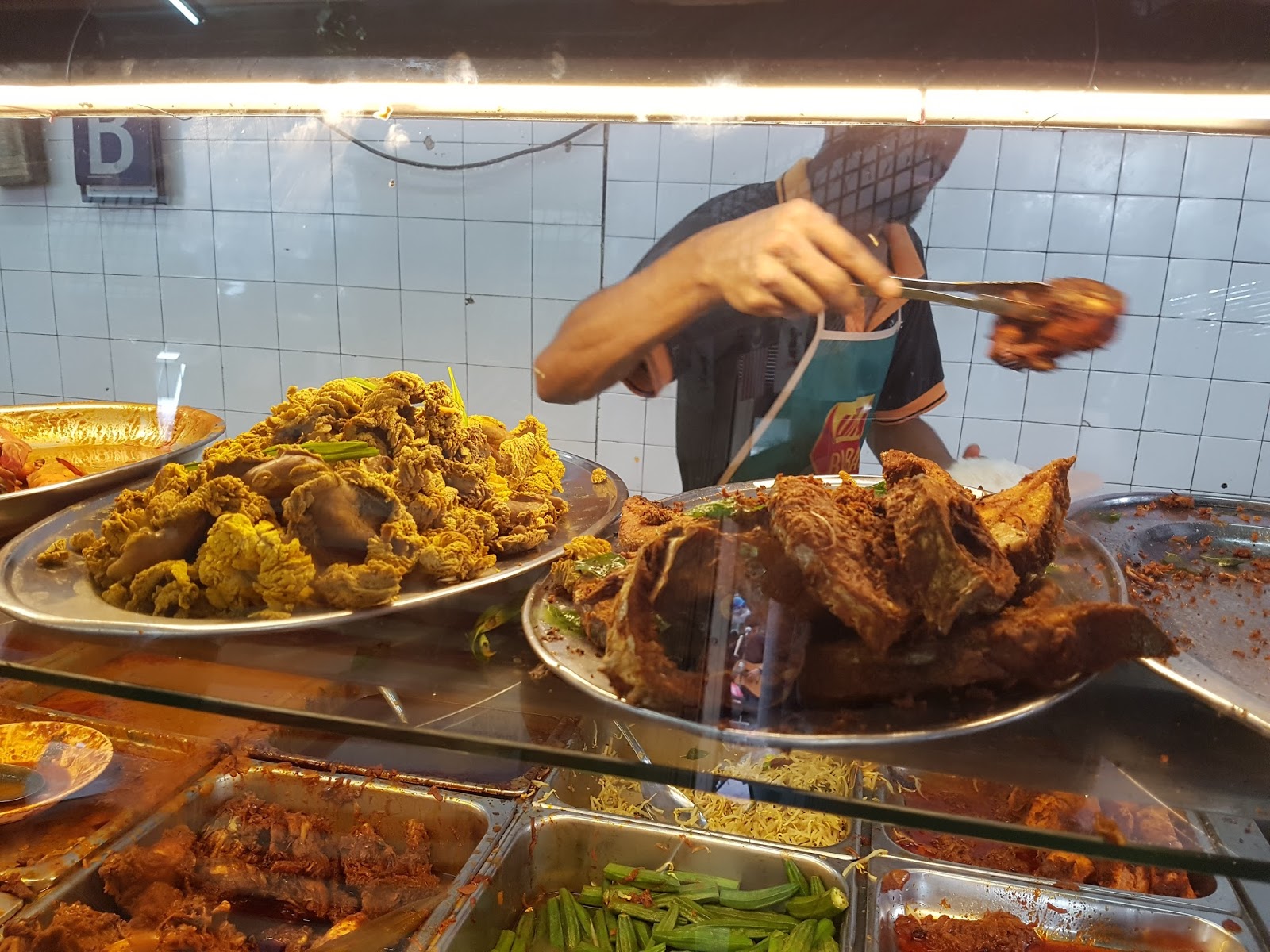
As the name implies, nasi kandar is basically rice and curry and has its origins from indian muslims who migrated to Penang back in the day. Typically white rice on which a mix of various curries is poured onto (called "banjir" or "flooding" by locals), and served with various side orders such as fried chicken, beef spleen, cubed beef, lamb, fish roe, fried prawn or fried squid. Vegetables such as lady's finger/okra, green chillies, fried bittergourd, aubergine or fried cabbage or beansprouts complete the meal.

Of course Penangites will insist that you can only find good Nasi Kandar in Penang itself. But what happens if you are not in Penang and have a craving for the dish?

If you are in Kuala Lumpur, then its not a problem. Forget all the modern nasi kandar chain restaurants that are all over the place, head over to Jalan Tuanku Abdul Rahman (formerly Batu Road).

There are three establishments which are famed for their nasi kandar here, Yaseen Nasi Kandar, Restoran Nasi Kandar Ibramsha and Restoran Kudu bin Abdul. Each restaurant has its fans, but to most the best nasi kandar is at Kudu's.


Restoran Kudu bin Abdul
Parking is difficult to get at Kudu's, especially on a week day, as there is limited road side parking. However, the restaurant is nearby the Medan Tuanku monorail station. Just walk out the Quill City mall side of the monorail station, go down the stairs (not into the mall) and walk along Jalan Sultan Ismail until you come to traffic light intersection with Jalan Tuanku Abdul Rahman (the Tune Hotel is opposite the road). Turn right and walk along Jalan Tuanku Abdul Rahman, and Kudu is on the corner lot of the block of shophouses.

The Corner Lot.
Kudu has been around since 1969 and was apparently a favourite of P. Ramlee, who was one of the famed actors of the time. The restaurant is a humble open-air restaurant with plastic chairs, tables and plastic plates, so not for those who are looking for fine dining!


Be prepared to queue.
At lunch time, there is always a queue, so you know that the food is good. Be prepared to queue for 20 to 30 minutes at least, and tables are also limited.

For those not in the know is, you don't sit down and wait for a menu! You need to queue to get to the food display counter to select the dishes that you want. Now maybe one of you may want to sit down at an empty table first to "reserve the table" but then someone else would need to queue for the poor guy. Best to do the honourable thing and all queue and hope that an empty table will magically appear later.


Sit at the communal long table and share the table with others.

The food display.
Once you get to the head of the queue, you tell the server what dishes that you want. The server will dish out a plate of white rice and "banjir" your rice with a mix of curries, then proceed to place your selected side dishes on the plate.

Fried fish.
Most food bloggers recommend going for the "ayam madu" (honeyed chicken) and fish eggs; as for me I went for the fried fish.

Okra, fried bean sprouts, curried eggs.
If you ask for okra or the green chillies (and you must, to keep it authentic), the server will take it by hand; so maybe not for the squeamish or hygiene conscious. Don't go into the kitchen then!

Green chillies, half boiled eggs, omelettes and of course the curries.
The server will hand you your plate and a slip of paper stating the cost of the meal. Go and find a place to sit down, attract a waiter's attention and order your drink.

Fried fish, bean sprouts, green chillies and okra.
Wash your hands at the sink, and proceed to eat with your hands. That is the authentic way to eat Nasi Kandar. Cutlery? Keep that for your five star restaurants! Just kidding, there is of course fork and spoons, but really the best way to eat is with your right hand. 

The bill? RM8.

Sirap bandung, a mix of rose syrup, evaporated milk and soda water.
After you have finished eating, go to the cashier counter and pay your bill.

Kudu
So if you are looking for authentic nasi kandar and you cannot go to Penang; head over to Kudu bin Abdul and get your curry fix.


Nasi Kandar Kudu bin Abdul 
Address: 335 Jalan Tunku Abdul Rahman, 50300 Kuala Lumpur.

Sunday, 12 February 2017

Thean Hou Temple, Kuala Lumpur

The Thean Hou Temple is a temple to the sea goddess Mazu (also known as Thean Hou or "Queen of Heaven", hence the name of the Temple) located in Kuala Lumpur, Malaysia. The temple was built by the Hainanese (people from Hainan in Southern China) living in Malaysia and the property belongs to and is run by the Selangor & Federal Territory Hainan Association.

On 30th Aug 1981, members of the association laid the foundation stone for the Thean Hou Temple, on 1.67 acres of land atop Robson Hill in Kuala Lumpur, Malaysia. Six years and RM 7 million later, the 4 storey Thean Hou Temple was finally completed and officially opened on 3rd September 1989.

The road up to the temple is along Persiaran Endah, off the busy 6-lane Jalan Syed Putra which connects Kuala Lumpur to the Federal Highway. The easiest way to get there is by car or private transport, as it is quite a steep walk up the hill and the nearest monorail station at Tun Sambanthan is a long walk away. 

However, if you do decide to take the monorail, you would need to get off at Tun Sambanthan, cross the Klang River and Jalan Syed Putra by the overhead pedestrian bridge to get to the Kuen Cheng High School on the other side. Then it is a 1.4km walk along the busy Jalan Syed Putra until you come to the Persiaran Endah intersection up the hill.

The temple is a modern building, but has traditional design elements from Buddhism, Taoism and Confucianism incorporated into the architecture. Multi-tiered roofs, ornate carvings and other embellishments make the overall appearance rather pleasing to the eye.

The Entrance Gateway
The front entrance of the temple is through a multi-arched gateway with red pillars, which is the symbolic colour of prosperity and good fortune. On the first level are souvenir stalls and a canteen. Going up the staircase leads you to the multi-purpose hall and administration offices.

The Prayer Hall

From the opposite side of the courtyard.

The internal courtyard
The third floor of the temple is where the main prayer hall is. As the temple is dedicated to Mazu, her sculpture occupies the central position of the main shrine. Next to Mazu are the Goddess of the Waterfront, Shui Wei Sheng Niang, a Hainanese deity and Guan Yin, the Goddess of Mercy.

Going up to the fourth floor is the actually the roof of the walkways below, and gives a view to the internal courtyard below and also externally out to the spectacular view of the Kuala Lumpur skyline beyond. Even the Petronas Twin Towers can be seen in the distance.

Multi-tiered roof of the Prayer Hall.

Roof over the staircase tower

KL Skyline with the KL Tower and Petronas Twin Towers.

Dragons on the roof eaves.
On the temple grounds itself, tourists can view the sculptures and paintings depicting myths relating to Mazu and other Chinese legends such as the 12 Zodiac animals and Yue Lao, the God of Marriage and Love. There is also a herb garden and tortoise pond to the rear of the temple. 

Tortoise Pond.

Thean Hou Temple

Address: 65, Persiaran Endah, Off Jalan Syed Putra, 50460 Kuala Lumpur.
Opening Hours: Monday-Sunday; 8am to 10pm