Gunung Rapat
is a limestone hill located 7km to the south-east of Ipoh, which is riddled
with caves. Over the years, many of these caves have been turned into temples
by devotees. Some of the cave temples located here include the Kek Look Tong,
Miaw Yuan Chan Lin, Kwan Yin Tong, Da Seng Ngan, Lin Sen Tong, Nam Thean Tong
and of course the Sam Poh Tong temple.
Sam Poh Tong
can be translated as the Cave of the Triple Gems. While the origin of the name
is unknown; it probably does not refer to actual jewels or treasures; but
probably the Triple Gems of Buddhism, the Buddha, the Dharma and the Sangha.
Some accounts say that the cave was discovered in 1890 by a passing
monk from China. The monk decided that the cave was a good place for him to
meditate and so he made the cave his abode. The monk lived there for the next
20 years until he eventually passed away. Subsequently it is said that a temple
was founded at the site of the monk’s cave in 1912 by local devotees. Sam Poh
Tong is thus said to be one of the earliest Buddhist cave temples in Ipoh.
 |
| Entrance to the Sam Poh Tong grounds. Beggars and hawkers selling water spinach ("kangkung") to feed the turtles. |
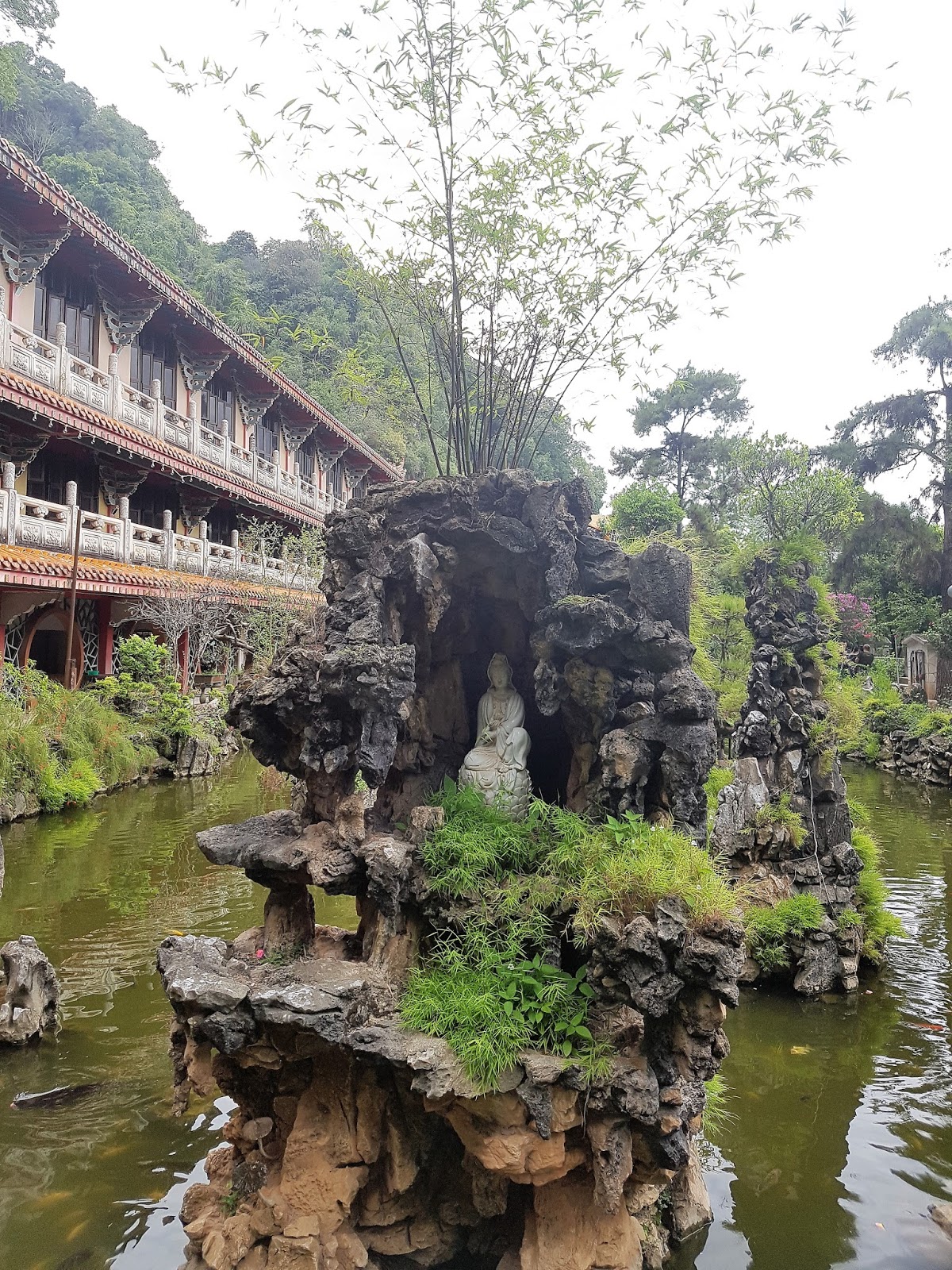
In front of the temple is a striking rock garden in an ornamental koi pond. Stone lanterns and sculptures decorate the rock garden, and while you initially may not pay too much attention; upon closer inspection of the rock garden, you will notice intricate miniatures of pagodas and other decorations amongst the rocks. The overall effect is quite pleasing to the eye, evoking mountainous landscapes like something out of China. A plaque on site states that the garden won the award of the best landscaped garden in Malaysia in 1993.
 |
| The rock garden. |
 |
| Stone lantern. |
 |
| Buddha in a cave. |
 |
| Koi swimming in the pool. |
 |
| Statue. |
 |
| Miniature bridge. |
 |
| Miniature pagoda. |
A "floating" pavillion sits on one side of the ornamental pool. Two dragon heads survey the scene set before them.
 |
| Floating pavillion. |
 |
| Dragon surveying his domain. |
The temple grounds also include a vegetarian restaurant, a crematorium and a columbarium.
Once you have finished exploring the grounds, you can make your way to the entrance to the actual cave temple.
 |
| Ceremonial archway into Sam Poh Tong. |
 |
| The cave entrance is surprisingly small. |
Once you enter the actual cave, you will actually be surprised by how small it actually is. The cave has also essentially been tamed; the floors have been concreted and tiles; and the walls and ceiling have been plastered.
 |
| Laughing Buddha. |
 |
| Steps lead upwards from the main cave. |
A staircase leads upwards to the right of the main altar. You can climb up these steps to get to the upper chamber.
 |
| Icons in glass cabinets. |
At the top of the staircase is the upper chamber where there are more buddhist icons in glass cabinets. You can also peer down to the lower chamber from here.
 |
| Steps lead down from the upper chamber to the outside. |
From the upper chamber, you can climb more steps which will lead you to a barricaded opening with steps leading up the mountain. From behind the bars, you can see that the steps are overgrown with shrubbery and not maintained. Some old descriptions of Sam Poh Tong mention that you can climb 246 steps to an open cave with a commanding view of Ipoh. Perhaps these are the steps in question?
Since you cannot continue up, another doorway leads down and out to an open terrace facing the front of the cave. From here you can see the back of the ceremonial arch and the temple grounds.
 |
| View of the back of the entrance arch. |
After peering out to see the view, you can walk back to see one last chamber, also blocked off with a barricade. At the time of our visit, the door was open, and we walked in to see this many armed statue.
 |
| The final upper chamber. |
 |
| Inside is this many armed statue. |
Once done, make your way back down to the main cave, walk pass the Laughing Buddha altar, and you will come to another altar.
 |
| Another altar. |
Once pass this altar, a passageway leads off to the right. Follow this passageway until you reach the end, where a surprise awaits you.
 |
| Passage leading to the hidden valley. |
At the end of the passageway, natural light floods in, and you will see that you are inside a hidden valley completely encircled by the limestone hills. The only way in and out of this hidden valley is by the passageway you came in through.
 |
| Icons in the hidden valley. |
Inside the hidden valley is a tortoise pond. People will feed
kangkung, or water spinach bought from the hawkers outside, to the turtles for merit-making.
 |
| Turtle Pond |
Unfortunately, the turtles in the turtle pond do not seem to be living in hygienic surroundings and are fenced in. Perhaps the temple management could see how to improve their living condition.
Besides the turtle pond, there is also an abandoned pagoda in the valley. The gates are barricaded and you cannot enter; but its presence gives the valley an eerie and mysterious appearance.
 |
| Abandoned Pagoda. |
Curiously there is a statue of a Roman-like figure in front of the temple, not something you would expect in a Buddhist temple!
 |
| Surreal and desolate. |
Sam Poh Tong is especially packed during Ching Ming when relatives
of the deceased come to pay respect to their ancestors. Relatives leave behind
food and offerings to their dearly departed. However at other times, Sam Poh
Tong seems forlorn and quiet.
There is a general air of neglect and decay that
pervades the atmosphere of the temple; as if there is no longer any will to
upkeep and maintain the temple grounds. Stray dogs wander the grounds and beggars line the gates. Some areas of the temple are barricaded off from entry and appear run-down. This
is a pity, as Sam Poh Tong has a lot going for it if it is well-maintained.
Hopefully the caretakers will take note and do something to return Sam Poh Tong
to its heyday.
Sam Poh Tong
Address: Sam Poh Tong, Off Jalan Sultan Nazrin Shah, 31400 Ipoh, Perak.